Skip to content



Mattress for Side Sleepers
Sleeping on your side is one of the most common sleeping positions. It is also one of the most challenging in terms of proper pressure distribution and spinal support.
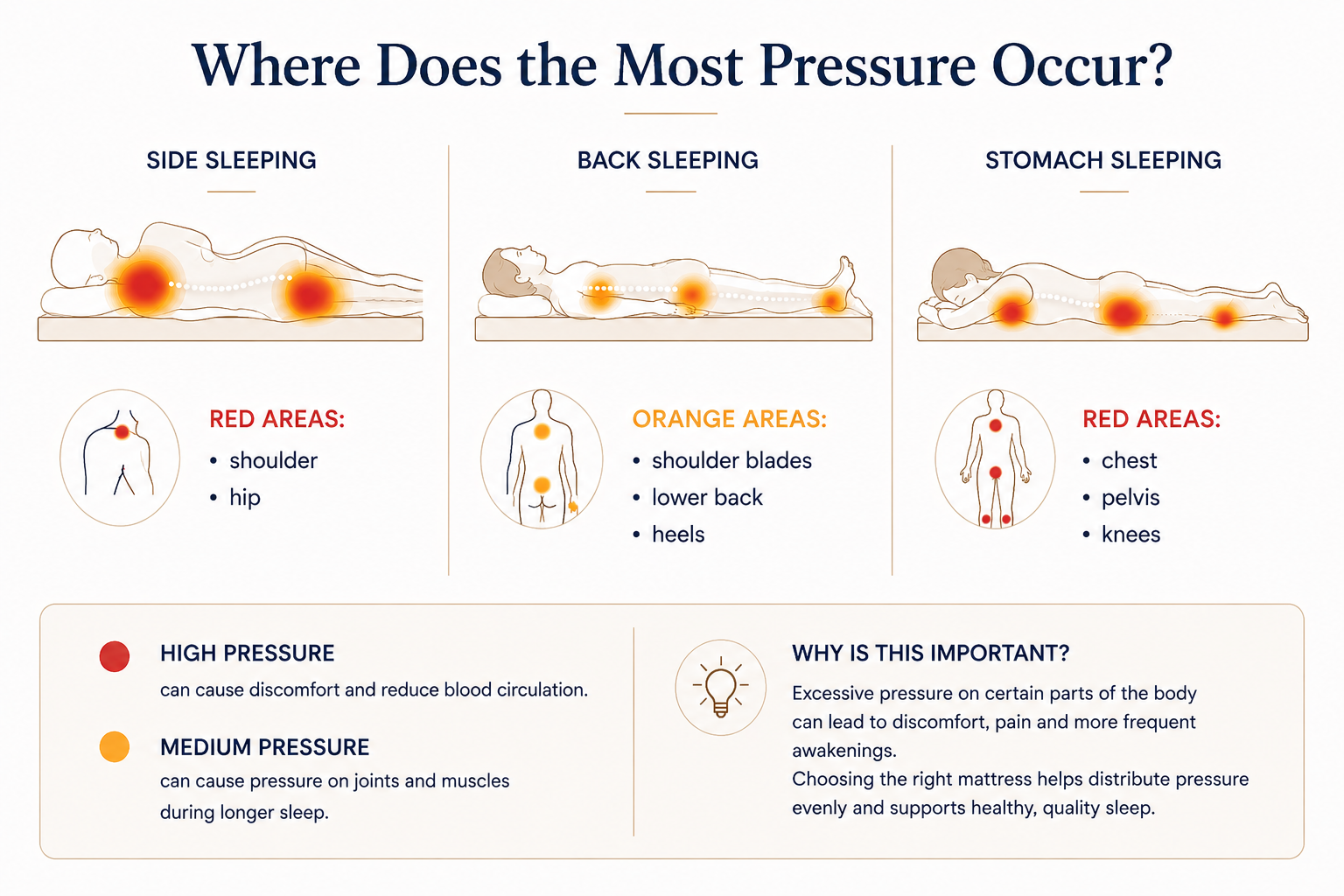
The greatest pressure is exerted on the shoulders and hips
When we lie on our side, most of our body weight is concentrated on relatively small areas—the shoulders and hips. If the mattress is too firm, these parts of the body cannot sink in sufficiently. As a result, the spine deviates from its natural alignment, and the muscles remain under unnecessary tension throughout the night.
However, a mattress that is too soft is not the ideal solution either. If your hips sink in too deeply, your spine once again loses proper support.
What characteristics should a mattress have?
For people who most often sleep on their side, a combination of flexibility and stable support is important. The mattress should allow the shoulders and hips to sink in naturally, while still providing sufficient support for the lumbar region of the spine.
Mattresses with a high–quality spring core and comfortable natural layers that flexibly respond to pressure from different parts of the body offer a major advantage. As a result, body weight is distributed more evenly, and the spine remains in a natural position during sleep.
Choosing the right mattress always depends on body weight, height, body proportions, and individual preferences. Two people who sleep on their sides may not need the same type of mattress.
Mattress for sleeping on your back
Sleeping on your back allows for a more natural distribution of body weight than sleeping on your side. However, proper body support plays a crucial role in this case as well.
The natural curvature of the spine must be maintained
The spine should not be completely straight while you sleep. It has a natural curve in both the neck and lower back, which a high-quality mattress should accommodate.
If the mattress is too firm, a gap forms between the lower back and the surface of the mattress. As a result, the back muscles remain slightly tense even while resting.
On the other hand, if the mattress is too soft, the pelvis may sink in too much, which in turn leads to improper spinal alignment.
What hardness is usually appropriate?
For sleeping on your back, a mattress that provides firm yet flexible support is usually best. More important than the firmness level itself is the mattress’s ability to respond to the distribution of body weight and ensure proper support for the spine.
With high-quality mattresses, therefore, it is not just the firmness rating that matters. The overall comfort is primarily influenced by the core’s construction, the materials used, and the way the individual layers work together to support the body.
Mattress for sleeping on your stomach
Although experts generally do not consider sleeping on one’s stomach to be the best position for the spine, many people feel comfortable in this position and fall asleep this way. The goal, therefore, is not to change established habits, but to choose a mattress that provides the body with the best possible support.
Why is this position more challenging?
Sleeping on your stomach causes the spine to curve more, especially in the lower back. At the same time, your head is turned to one side, which can increase tension in the neck, shoulders, and upper back.
If your pelvis sinks too deeply into the mattress, the natural curvature of your spine will become even more pronounced. Conversely, a mattress that is too firm can put uncomfortable pressure on your chest, shoulders, or knees.
What to Look for When Making a Choice
People who most often sleep on their stomachs generally benefit from a mattress that provides firm support, which helps prevent the pelvis from sinking too far. At the same time, however, it should remain flexible enough so as not to put pressure on exposed parts of the body.
Choosing the right pillow is also important. A pillow that is too high can increase strain on the cervical spine, so it is advisable to consider the mattress and pillow as a single functional unit.